David Williams OBE FREng and Dr Nicholas Harlow
At the end of 2024, the Heritage and Collections Committee of the Worshipful Company of Gunmakers was directed by the Master, Wardens and Court of Assistants to review the condition of the Company’s Charter and Ordinances, with a view to their long-term conservation.
Following inspection, Court Assistant Williams advised that urgent conservation work was required. The Court acted decisively, commissioning immediate intervention. Work began in early 2025 and, on 14 October that year, the Master led a small group to the Conservation Studio at The London Archives to review progress.
We were welcomed by Miles Mears, Conservation Manager, Tim Warrender, Senior Conservator, and Howard Doble, Senior Archivist.
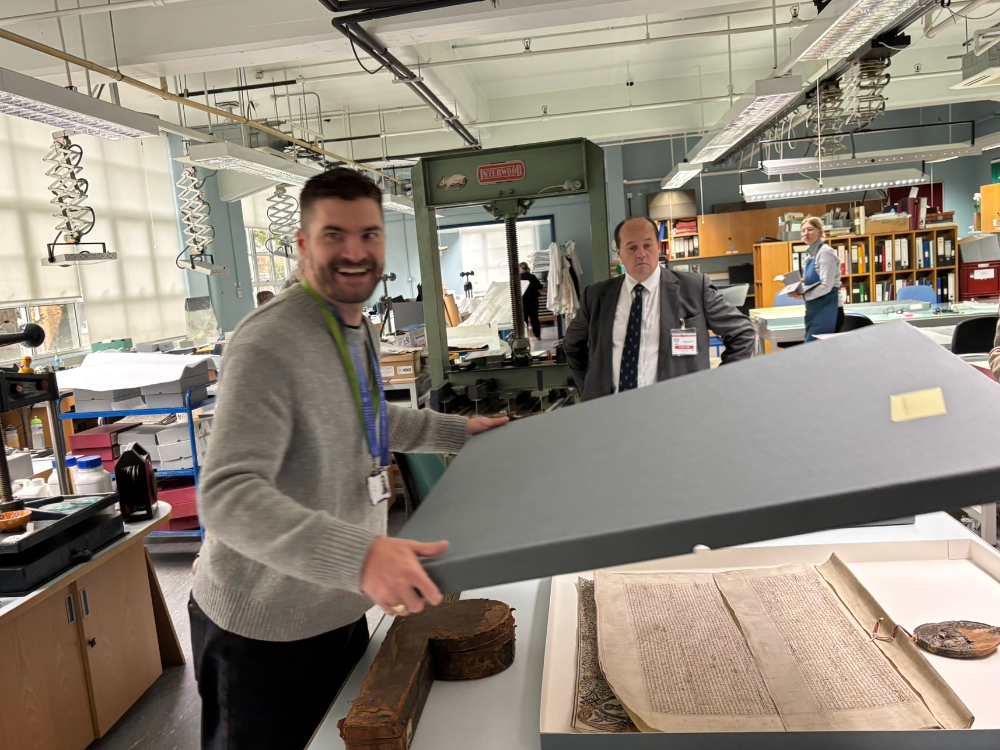
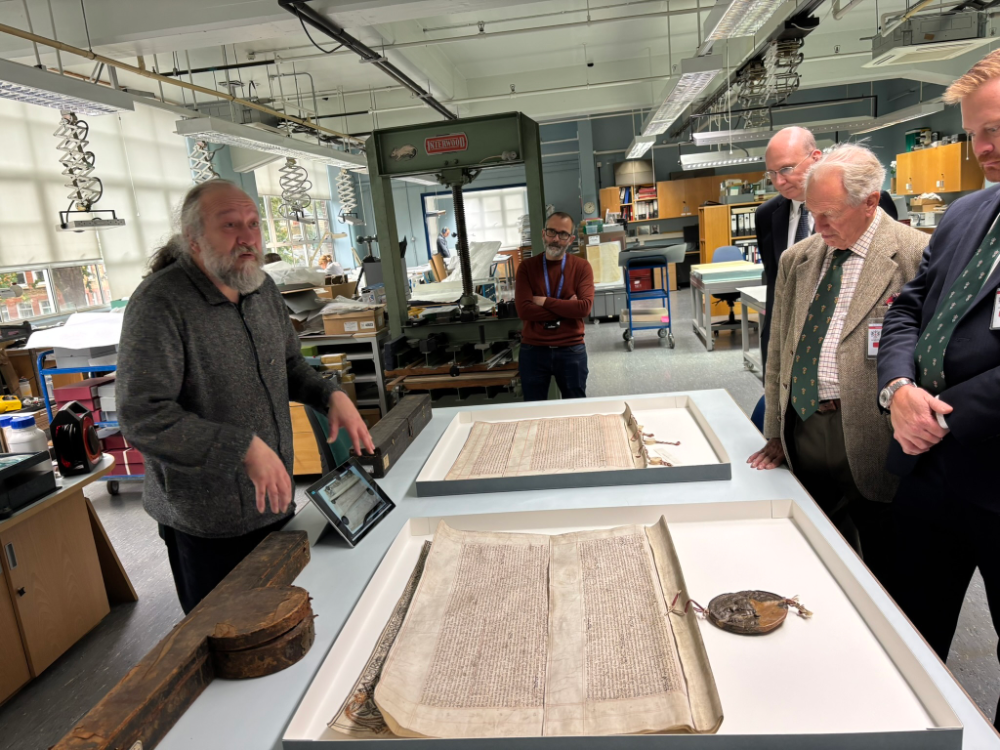
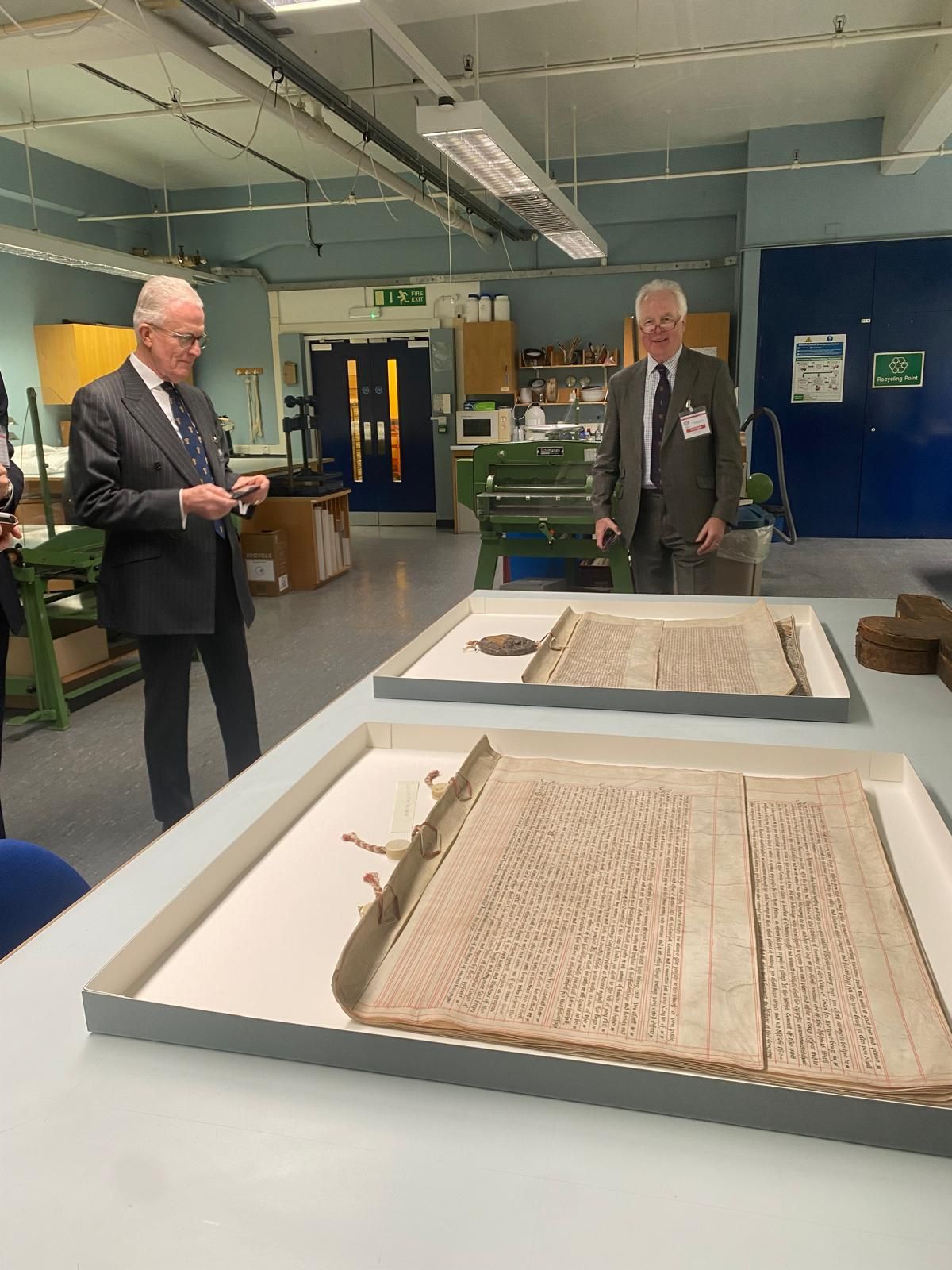
Gathered around the central table of the studio, we witnessed what could best be described as an unveiling. The lids of two bespoke, museum-grade conservation boxes were carefully removed, revealing the Charter and Ordinances.
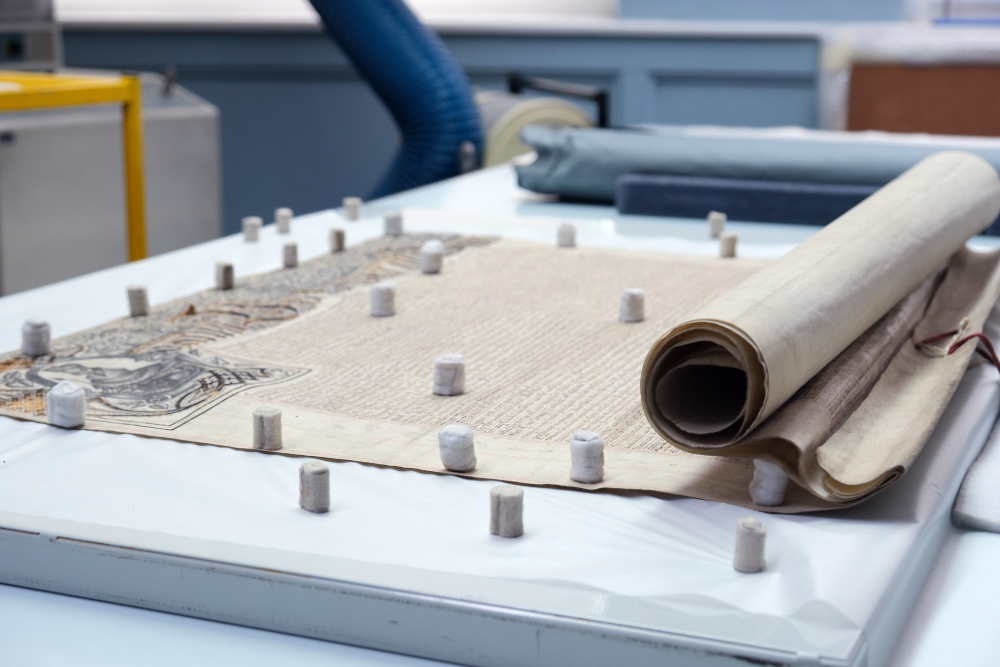
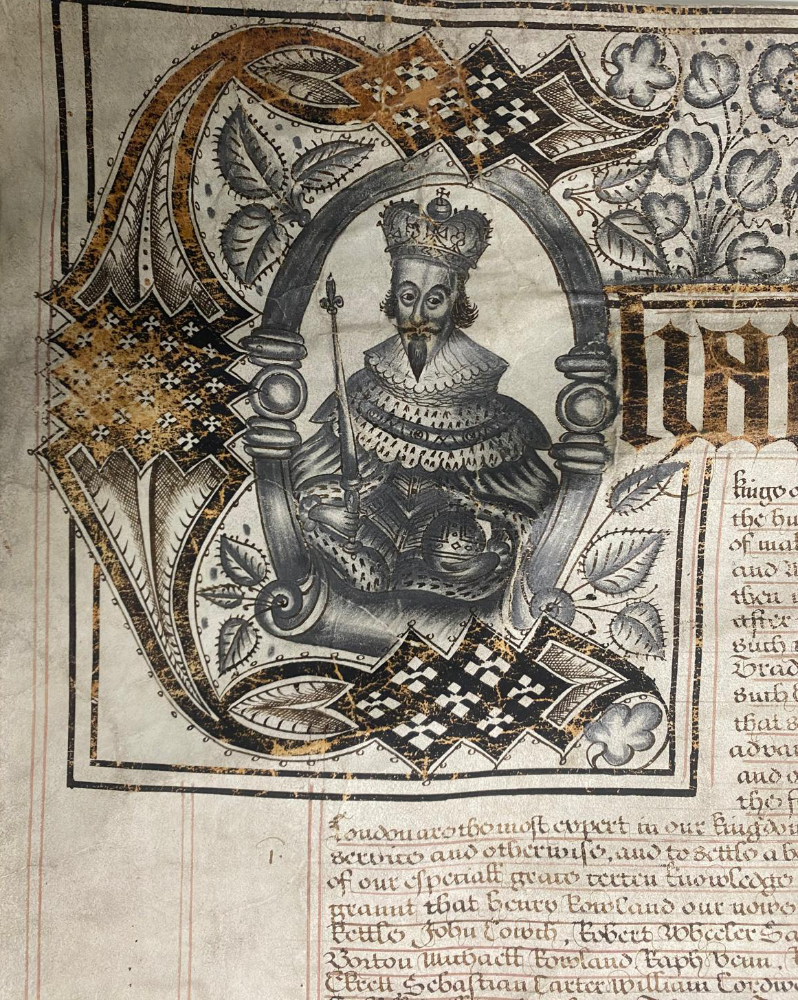
Previously, both documents had been tightly rolled within their original storage cases—an approach that restricted access and, over time, caused damage. The initial stage of work involved carefully flattening and cleaning the vellum, followed by meticulous conservation treatment. Tim explained the delicate techniques used, including a near-invisible repair to the Charter’s decorated initial using fine Japanese handmade paper. He also emphasised the importance of rehousing the documents flat within a stable, controlled micro-environment.
Before us lay the Company’s two defining instruments:
- The Charter of 1637, naming our first Master, Henry Rowland, and the founding freemen gunmakers
- The Ordinances of 1670, setting out the governance and daily operation of the Company
As the significance of what we were seeing settled, so too did a quiet realisation: both documents are approaching 400 years in age.
Attention then turned to the details. The repair to the Charter’s initial was almost imperceptible, visible only as fine slivers of reinforcement on the reverse. A small hole in one sheet—originating from an insect bite in the animal skin before it was prepared as vellum—had expanded during the stretching process. The original Ordinances box was found to be lined with pages from a Latin astronomy text, while the three official seals were housed in finely crafted, threaded ivory containers.
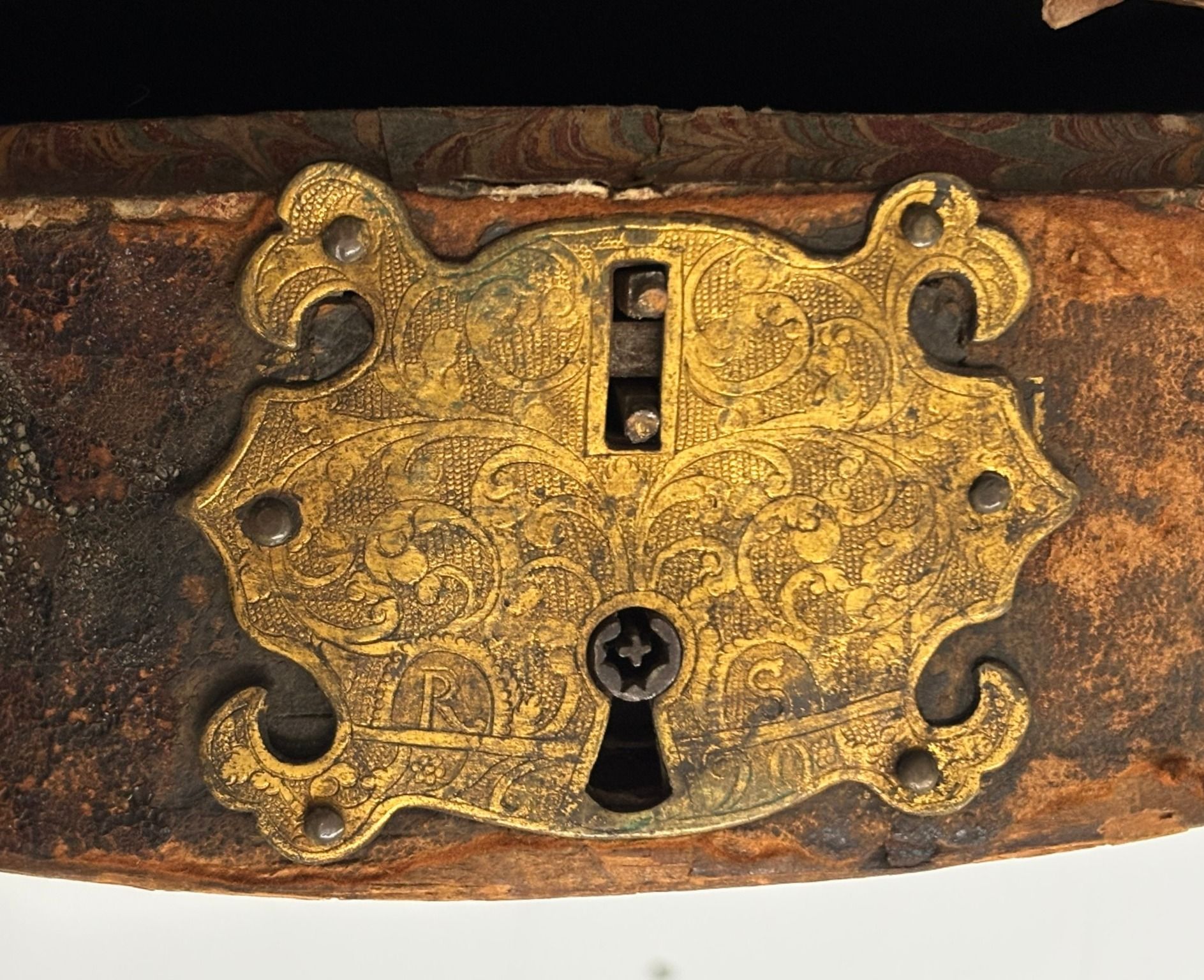
The Charter’s original box bears a gilt-brass escutcheon dated 1690, engraved ‘RS’. It is likely this refers to Robert Silke Senior, who served as Master that year and was Chief Gunmaker at the Tower of London. The Silke family formed part of the dynastic backbone of the Company. As recorded in Liveryman Howard Blackmore’s work, John Silke was Master in 1655—the year the Company began accepting apprentices—while his successor, also John Silke, served in 1660 and was among those arrested by the Blacksmiths’ Company in 1656.
The Digital Studio has produced high-resolution archival photography of each page—four for the Charter and eight for the Ordinances—ensuring accurate digital preservation. The seals have also been separately conserved and boxed.
The final phase of the project will see the professional scanning of the Charter seal and the creation of a 3D-printed replica. This represents a first for The London Archives, placing the Gunmakers at the forefront of applying additive manufacturing to heritage conservation.
This work has been made possible through the generosity of members of the Court, for which the Heritage and Collections Committee records its sincere gratitude.
The documents are now secured through a preventative conservation approach and are significantly more accessible for study. This will allow the Company to examine their contents in greater detail, deepening understanding of how these historic instruments continue to inform its present governance.
During our visit, representatives from the College of Arms were also present and expressed particular interest in examining an original Charter of King Charles I, as part of their own research.
Image Caption
1. Myles Mears reveals our charter
2. Tim Warrender explains the conservation process
3. The flattening process
4. A relieved Clerk and Heritage and Collections Committee Chair
5. The conserved initial of the Charter
6. The escutcheon on the Charter Box with RS and 1690